Baseball cards have transformed from childhood collectibles into serious investments worth thousands or even millions of dollars. The difference between a card worth $50 and one worth $5,000 often comes down to a single factor: its grade. Professional baseball card grading provides collectors with an objective assessment of condition, authenticity, and value, creating a standardized language that buyers and sellers trust across the marketplace. Understanding how this process works is essential for anyone looking to build a valuable collection or sell cards at their true market worth.
What Makes Baseball Card Grading Essential
Professional grading services evaluate cards using standardized criteria that eliminate subjective opinions from the equation. When you submit a card for grading, experts examine every millimeter of the surface, edges, corners, and centering to assign a numerical score.
This process serves multiple purposes for collectors and dealers alike. Authentication protects buyers from counterfeits and altered cards, which have become increasingly sophisticated. Preservation occurs when cards are encapsulated in tamper-proof holders that shield them from environmental damage. Value establishment gives both parties confidence in pricing, as graded cards command premium prices compared to raw cards in similar condition.
The grading industry has evolved significantly since its inception in the 1990s. Today's marketplace demands third-party verification, especially for high-value vintage cards and modern rookie cards of emerging stars. Without professional grading, determining whether a 1952 Mickey Mantle is worth $50,000 or $500,000 becomes nearly impossible.
Understanding the Grading Scale and Criteria
Most major grading companies use a 10-point scale, though the specific breakdowns and terminology vary. A PSA 10 (Gem Mint) represents a virtually perfect card, while lower grades indicate increasing levels of wear, defects, or printing flaws.
The Four Pillars of Card Evaluation
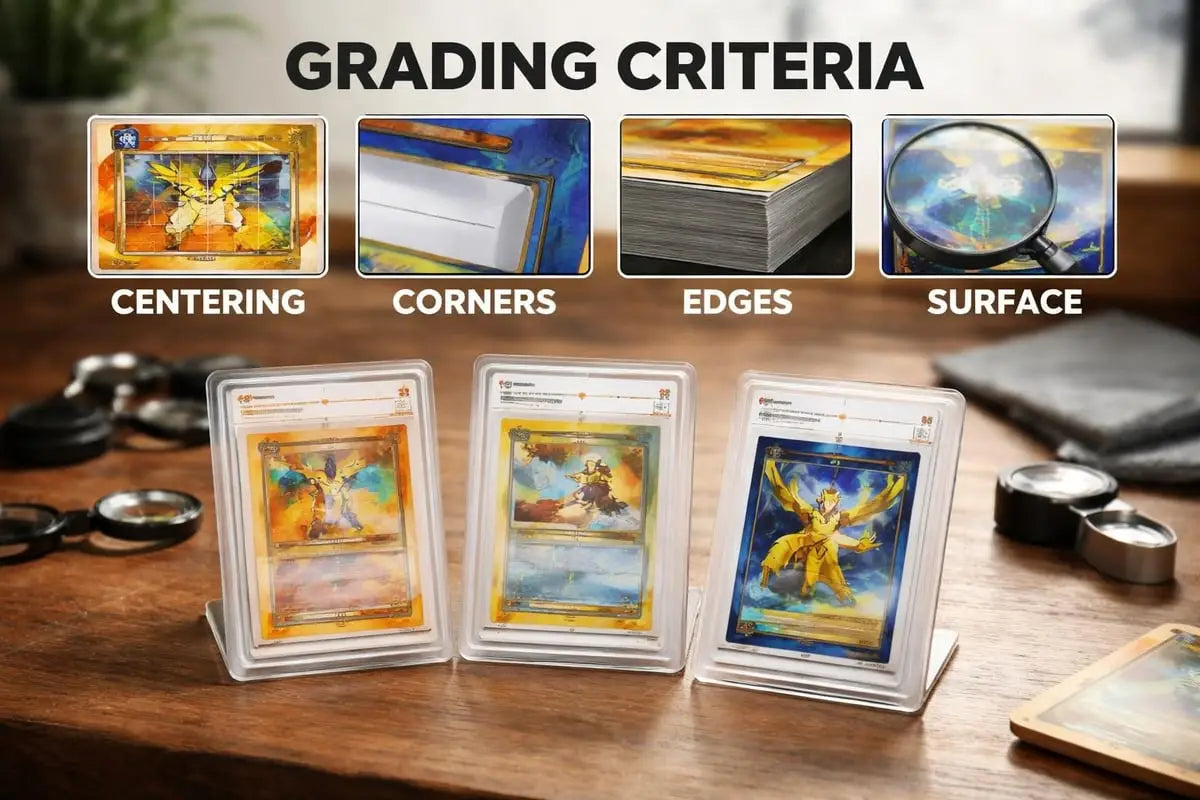
Baseball card grading relies on four fundamental criteria that determine the final grade:
- Centering: The border measurements from the image to the card edges, typically requiring 60/40 or better for top grades
- Corners: Sharpness and wear at all four corners, with any softening or whitening reducing the grade
- Edges: The condition of the card's perimeter, checking for chipping, wear, or roughness
- Surface: Print quality, gloss retention, scratches, stains, or other blemishes on the card face
According to research on subgrade rankings, centering and corners typically carry the most weight in determining overall value, though surface issues can dramatically impact even well-centered cards.
Common Grade Designations
| Grade | PSA Label | Condition Description | Market Impact |
|---|---|---|---|
| 10 | Gem Mint | Perfect or near-perfect card | 5-10x raw value |
| 9 | Mint | Minimal imperfections | 3-5x raw value |
| 8 | NM-MT | Slight wear visible | 2-3x raw value |
| 7 | Near Mint | Minor flaws apparent | 1.5-2x raw value |
| 6 | EX-MT | Moderate wear | Similar to raw |
| 1-5 | Various | Significant issues | Often less than raw |
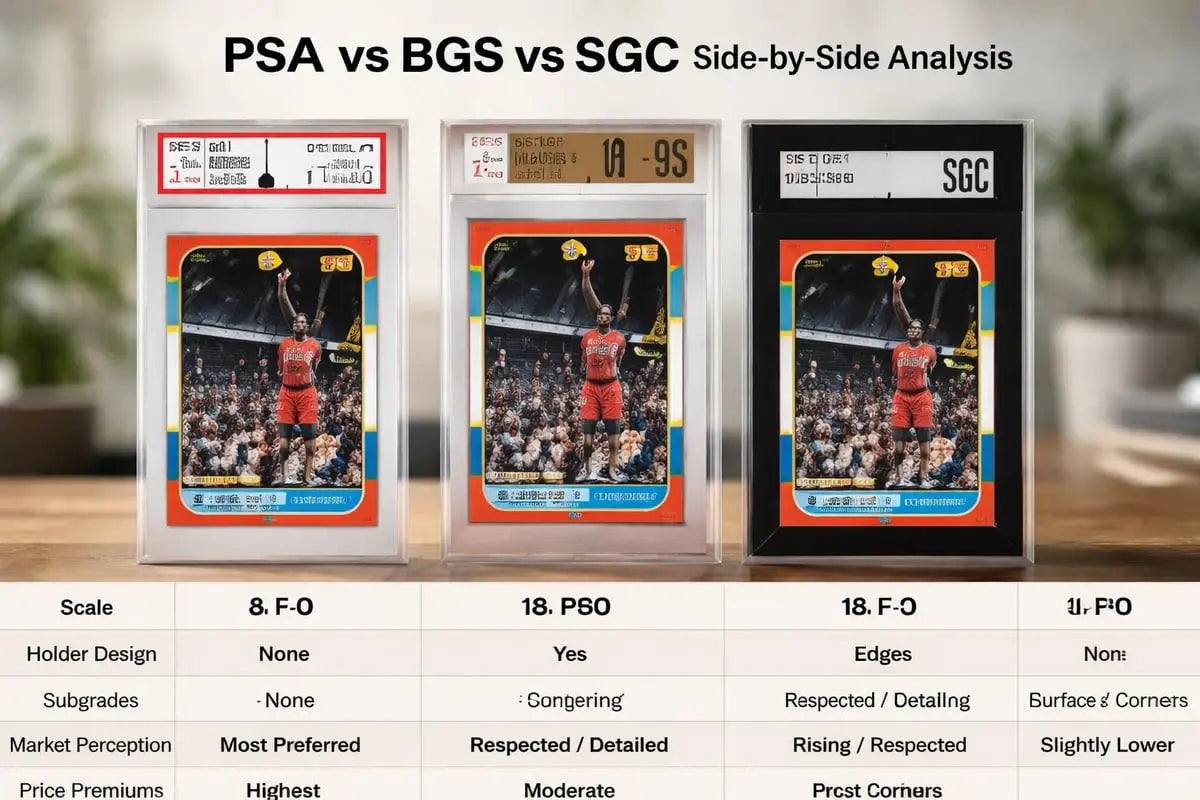
Different services also use subgrades that break down the four criteria individually. A card might receive an overall grade of 9 while showing a 9.5 for surface and an 8.5 for centering. These details matter significantly to serious collectors who understand how different grading scales compare across services.
Major Baseball Card Grading Companies
Three companies dominate the baseball card grading landscape in 2026, each with distinct approaches and reputations among collectors.
PSA (Professional Sports Authenticator)
PSA holds the largest market share and typically commands the highest resale premiums. Their straightforward 1-10 scale without subgrades appeals to mainstream collectors and investors. PSA population reports show how many examples of each card exist at each grade level, helping collectors assess rarity.
Turnaround times range from 10 business days for express service to 65 business days for value submissions. Pricing starts around $25 per card for bulk submissions and increases for higher-value cards or faster service.
BGS (Beckett Grading Services)
Beckett pioneered the use of subgrades, providing scores for centering, corners, edges, and surface alongside an overall grade. Their coveted Black Label designation requires perfect 10s across all four subgrades, making it the rarest and most valuable grade in the industry.
BGS appeals particularly to modern card collectors who value the detailed feedback subgrades provide. Their holders feature a distinctive appearance that stands out in display cases.
SGC (Sportscard Guaranty Company)
SGC has gained significant ground in recent years, especially among vintage card collectors. Their reputation for consistent, conservative grading and competitive pricing has attracted collectors seeking alternatives to PSA. The company uses a 1-10 scale with half-point increments for certain grades.
Many veteran collectors appreciate SGC's attention to vintage card authentication, an area where the company has built particular expertise over decades of operation.
The Submission Process Step by Step
Sending cards for professional grading requires careful preparation and attention to detail. Following proper procedures protects your investment and ensures accurate evaluation.
Preparation and Selection
- Identify candidates: Examine raw cards under bright light to estimate potential grades
- Research values: Compare recent sales of graded examples to ensure submission costs justify potential returns
- Gather supplies: Obtain card savers, sleeves, and submission forms
- Create inventory: Document each card with photos and descriptions before shipping
Not every card deserves professional grading. The submission fees, shipping costs, and insurance add up quickly. Focus on cards where grading will add significant value or where authentication is essential.
Submission Methods
Most collectors choose between direct submission to grading companies or working through authorized dealers. Direct submission offers lower per-card costs but requires minimum quantities and longer wait times. Dealers provide convenience and faster service for premium fees.
Online submission portals have streamlined the process considerably. You can now upload card information, select service levels, and pay fees before shipping. Detailed grading service standards vary by company, so review requirements carefully before submitting.
Packaging and Shipping
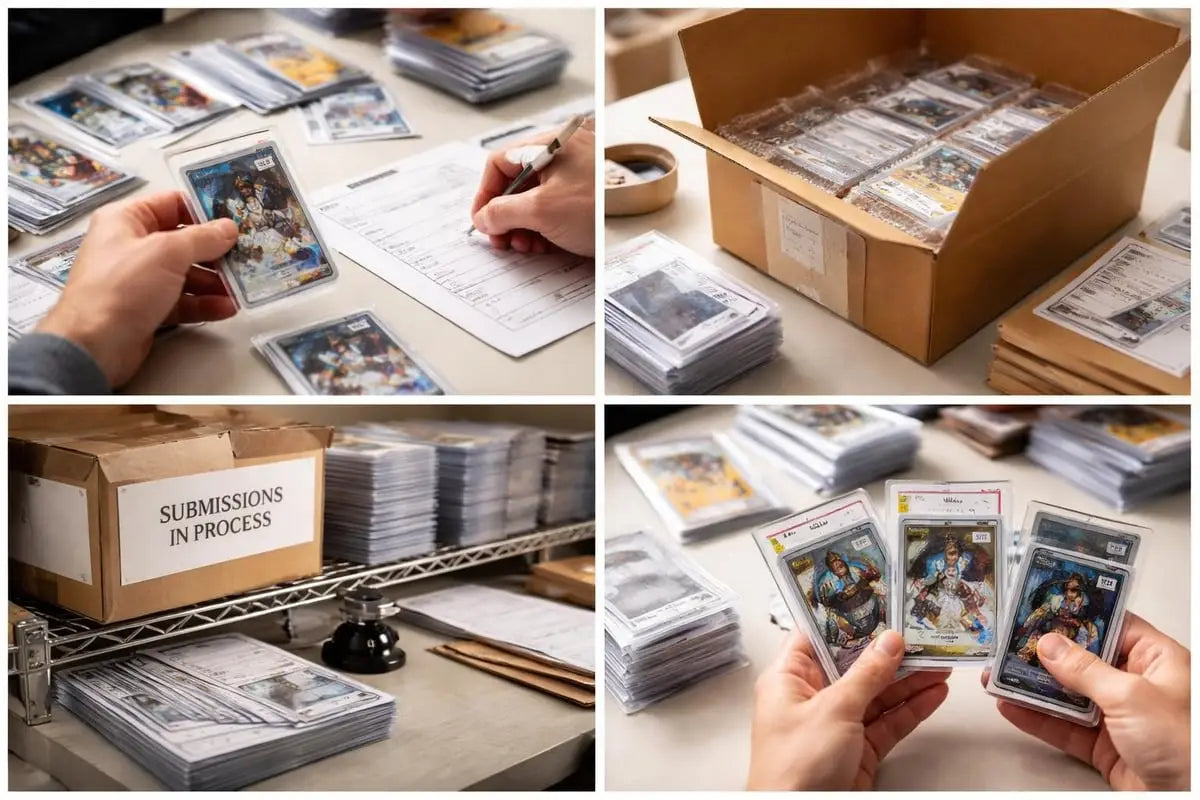
- Place each card in a penny sleeve, then into a semi-rigid card saver
- Arrange cards vertically in shipping boxes with adequate padding
- Include submission forms with accurate card descriptions and declared values
- Use tracked, insured shipping appropriate to the total declared value
- Photograph packaging and cards before shipping for documentation
Insurance becomes critical when shipping valuable collections. Declare full retail replacement value and retain all receipts and tracking information.
Factors That Influence Grades and Values
Understanding what graders look for helps collectors make smarter purchasing and submission decisions. Minor differences in condition can mean massive price variations.
Print Defects Versus Damage
Grading services distinguish between factory defects and post-production damage. A card might leave the printer with off-center borders or print lines, while handling causes corner wear or surface scratches. Both issues lower grades, but market perception differs.
Factory defects are original to the card and affect all copies from certain print runs. Post-production damage results from storage, handling, or environmental factors. High-grade examples of cards known for centering issues command premiums because true gem copies are scarce.
Era-Specific Considerations
Vintage cards from the 1950s through 1970s face different expectations than modern issues. Graders account for the production methods and materials available during each era. A 1965 card showing slight tilt in cutting might grade higher than a 2015 card with identical centering because printing technology has improved dramatically.
Similarly, the sports card grading standards applied to other categories like NBA trading cards or football cards share these same fundamental principles while accounting for their specific characteristics.
The Population Report Impact
Scarcity drives value in collectibles markets. Population reports track how many cards have been graded and at what levels. A card with only three PSA 10 examples becomes exponentially more valuable than one with three hundred perfect grades.
Smart collectors research population data before purchasing graded cards or submitting raw cards. A card that appears perfect might already have dozens of 10s in the population, limiting upside potential. Conversely, a card that grades 9 might represent the highest known example, making it surprisingly valuable.
Strategic Considerations for Collectors
Baseball card grading decisions should align with your collecting goals and budget constraints. Different strategies make sense for investors versus hobbyists.
When to Grade and When to Wait
| Scenario | Grade Now | Wait/Don't Grade |
|---|---|---|
| Recent rookie sensation | Yes - capture peak interest | No - if performance uncertain |
| Vintage Hall of Famer | Yes - authentication critical | No - if clearly damaged |
| Modern base commons | No - fees exceed value | No - unless error/variation |
| Inherited collection | Yes - high-value keys | No - low-value bulk |
| Investment flip | Yes - maximize sale price | No - if margins too thin |
Calculate the total cost including submission fees, shipping, insurance, and your time. Compare this against the expected value increase from grading. Many modern cards cost more to grade than the graded version sells for on the secondary market.
Building a Graded Collection
Collectors focused on graded cards should develop expertise in evaluating holders and labels. Counterfeit holders exist, though they remain relatively rare for major grading services. Check security features like holograms, font consistency, and holder construction quality.
The CGC graded baseball cards available through specialized retailers provide verified authenticity and save collectors the hassle of submitting cards themselves. This approach works particularly well for building sets or acquiring specific players.
Market Timing and Grade Crossovers
Some collectors submit cards to multiple grading companies hoping for grade improvements, a practice called "crossover." A card in a PSA 8 holder might be cracked out and resubmitted to BGS seeking a higher grade or valuable subgrades.
This strategy carries risks. Removing cards from holders can damage them, and resubmission might result in lower grades than the original. Additionally, different services have different market perceptions. PSA 9s typically sell for more than BGS 9s for most vintage cards, while BGS attracts premiums for modern cards with pristine subgrades.
The Economics of Graded Cards
Professional grading creates measurable value that transforms the collectibles marketplace. Understanding these economics helps collectors make informed decisions about submissions and purchases.
Premium Multipliers by Grade
The value jump between grades accelerates dramatically at the top end of the scale. A common modern card might sell for $10 raw, $15 in a PSA 8, $30 in a PSA 9, and $200 in a PSA 10. That 10x multiplier from 9 to 10 reflects scarcity and collector demand for perfection.
Vintage cards show even more pronounced spreads. A 1970s star player card worth $100 in PSA 8 condition might reach $500 in PSA 9 and $5,000 in PSA 10. These gaps justify the careful examination and strategic submission planning serious collectors employ.
Submission Cost Versus Return Analysis
Current submission fees for major services range from $20 to $150+ per card depending on service level and declared value. Express and super-express tiers cost significantly more but deliver results in days rather than months.
Calculate break-even points before submitting. If a card sells for $50 raw and $100 graded, the $30 submission cost plus shipping and insurance leaves minimal profit. However, a $200 raw card that achieves a high grade and sells for $800 graded provides substantial return on investment.
Bulk submission programs reduce per-card costs but require volume minimums and longer turnaround times. These work well for dealers and high-volume collectors but less so for hobbyists with occasional submissions.
Market Liquidity Benefits
Graded cards sell faster and with greater buyer confidence than raw cards. The third-party verification eliminates condition disputes and buyer hesitation. Online marketplaces show higher sell-through rates and fewer returns for graded inventory.
This liquidity advantage matters when selling entire collections or individual high-value pieces. Serious buyers prefer graded examples because they can purchase with confidence, often sight unseen based on the grade and photos of the holder.
Common Mistakes to Avoid
Even experienced collectors make errors that cost money and opportunity in the grading process. Learning from common mistakes saves frustration and maximizes returns.
Misestimating Grades
Novice collectors consistently overestimate their cards' potential grades. What appears to be a perfect card under casual inspection often reveals centering issues, print defects, or subtle corner wear under grading room magnification.
Before submitting valuable cards, practice grading inexpensive examples from the same era and manufacturer. Study sold listings of graded cards to calibrate your eye. Consider pre-screening services that evaluate cards before official submission.
Inadequate Research
Failure to check population reports, recent sales data, and market trends leads to poor submission decisions. A card might grade well but already exist in large quantities at that grade level, limiting value appreciation.
Comprehensive baseball card grading guides provide the foundation knowledge necessary to make informed choices about which cards deserve professional evaluation and which should remain in your collection ungraded.
Improper Handling and Storage
Damaging cards before submission through careless handling defeats the entire purpose of grading. Always hold cards by the edges, work over soft surfaces, and use clean hands or cotton gloves.
Storage conditions matter tremendously. Cards kept in humid environments develop warping or surface issues. Direct sunlight fades colors. Temperature fluctuations cause holder damage to already-graded cards. Maintain climate-controlled storage and use appropriate holders and boxes.
Ignoring Service Reputation
Not all grading companies carry equal weight in the marketplace. Several defunct or questionable services have operated over the years, leaving collectors with cards in holders that buyers don't trust. Stick with established, reputable companies that maintain consistent standards and widespread market acceptance.
The marketplace strongly favors PSA, BGS, and SGC for baseball cards. Other services may offer lower costs or faster turnaround, but the resale values rarely justify the savings.
Future Trends in Baseball Card Grading
The industry continues evolving with new technologies and changing collector preferences shaping how cards are evaluated and traded.
Technology Integration
Advanced imaging, artificial intelligence, and blockchain authentication are entering the grading process. Some companies now use high-resolution scanners to detect alterations invisible to the naked eye. AI algorithms help ensure consistency across different graders and time periods.
Digital certification tied to physical holders creates permanent authentication records that survive even if holders are damaged. These innovations address counterfeiting concerns and provide collectors with additional verification layers.
Market Expansion
Baseball card grading established the template now applied across the entire collectibles industry. The same companies grade soccer cards, Pokemon cards, and even non-sports items like Marvel trading cards. This expansion creates efficiencies and standardization across categories.
As international markets embrace grading, services are establishing facilities in Europe and Asia to serve global collectors. This geographic expansion reflects the worldwide growth of sports card collecting and investing.
Alternative Grading Models
Some collectors question whether numerical grades capture all relevant condition factors. Experimental services offer narrative descriptions, multiple certification levels, or specialized authentication without numerical grades.
Environmental consciousness has also prompted discussion about reducing plastic use in holders and developing sustainable encapsulation methods. How these concerns balance against protection and security requirements remains an active industry conversation.
Professional baseball card grading has become essential infrastructure in the modern collectibles marketplace, providing authentication, preservation, and standardized condition assessment that creates confidence for buyers and sellers alike. Whether you're building a personal collection, investing in vintage cardboard, or liquidating inherited treasures, understanding the grading process helps you make informed decisions that maximize value and minimize risk. When you're ready to explore professionally graded cards or need expert guidance on your collection, visit TradingCardsMarketplace, your trusted online source for trading cards and related collectibles.